
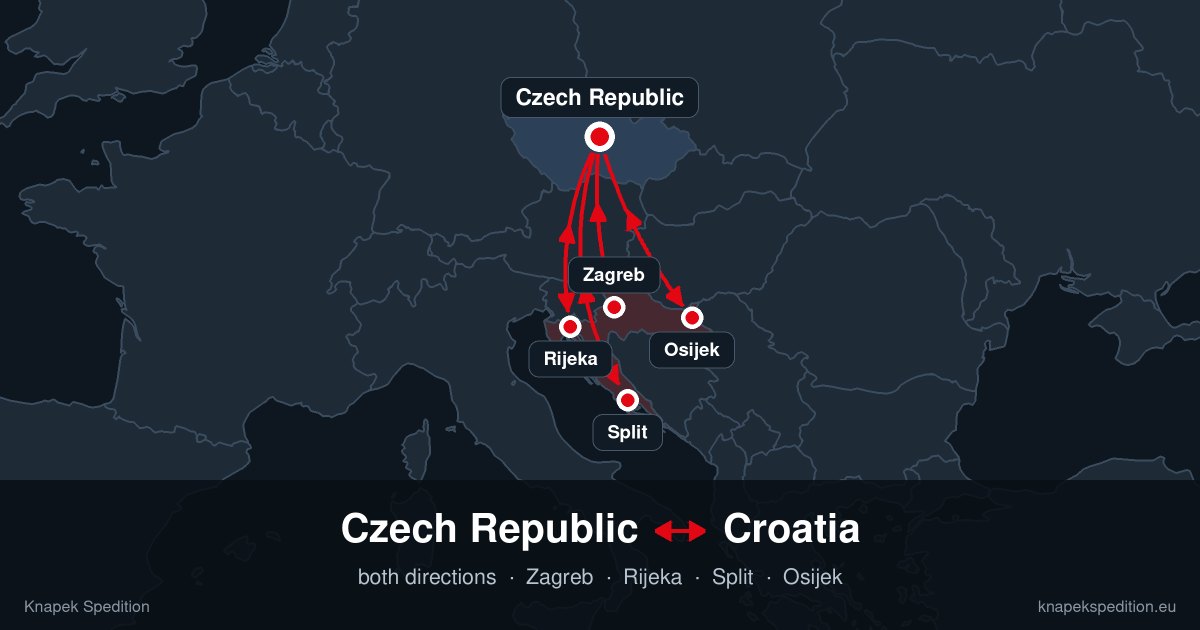
We arrange freight from Croatia to the Czech Republic as full truckloads, part loads and groupage from a single pallet. Goods from Zagreb and northern Croatia usually reach you in 1–2 days, from Dalmatia in about 2 days, and from the islands a little longer because of the ferry. We deliver to any address in the Czech Republic and Slovakia.
Imports of goods and material from Croatia usually mean food, beverages, electrical goods and timber. Shipping goods from the Czech Republic to Croatia can be arranged in the same enquiry.
Knapek Spedition, based in Břeclav, has organised imports from Croatia since 2011. Working with more than 500 vetted contracted carriers, we normally secure a vehicle within 24 hours of confirmation, whether the pick-up is in Zagreb or on the southern coast.
What do Czech companies import from which Croatian regions?
Croatia's economy is not concentrated in the capital alone. Plants and warehouses sit around Zagreb, in the north-west near Varaždin, at the port of Rijeka, in Istria, in Dalmatia and in agricultural Slavonia. Each area ships something different:
| Loading area | Typical goods | Transit to Czechia |
|---|---|---|
| Greater Zagreb – Zagreb | food and drinks, medicines, electrical equipment, printed products, stock from logistics centres | 1–2 days |
| North-west – Varaždin, Čakovec | clothing and textiles, metal parts, wooden products, confectionery | 1–2 days |
| Kvarner – Rijeka | goods released from the port terminal, sawn timber, steel structures | 2 days |
| Istria – Pula, Poreč, Pazin | wine, olive oil, natural stone, building components | 2 days |
| Dalmatia – Split, Zadar, Šibenik | natural stone, olive oil, wine, canned fish | 2 days, islands longer |
| Slavonia – Osijek, Vinkovci | palletised grain and flour, wood and furniture, farm produce | 2 days |
More Croatian cities and regions are listed below this text.
Which route does the truck take, and why does it matter?
Zagreb is about 720 km from Prague, Rijeka around 780 km and Split roughly 1,050 km. The route depends on where the goods are loaded. Cargo from Zagreb, Varaždin and Istria mostly travels through Slovenia and Austria to Mikulov or Břeclav. Loads from Slavonia head through Hungary and Slovakia, which avoids Austrian transit altogether. From Dalmatia the truck takes the A1 motorway to Zagreb and continues north from there. Croatian motorway tolls and charges in the transit countries are included in the price.
When the route crosses Austria, trucks over 7.5 t may not drive from Saturday 15:00 to Sunday 22:00 or on public holidays from 00:00 to 22:00. In the Czech Republic heavy trucks stop on Sundays and holidays from 13:00 to 22:00. In summer Croatia also restricts heavy vehicles on coastal roads, especially at weekends, so in the season we schedule Dalmatian collections on weekdays.
What should you watch out for when loading in Croatia?
- Old towns – trucks are not allowed into the historic centres on the coast. Loading takes place in an industrial zone, or a van collects the goods.
- Islands – Krk is reached by bridge, all other islands only by ferry. In summer the ferry is booked ahead and adds a day.
- Port of Rijeka – collection only after the terminal has released the goods. We need the container or warehouse number and the release reference.
- Stone and paving – heavy, so planning goes by weight rather than pallet count. A truck carries around 24 tonnes even if half the deck stays empty.
- Loading hours – manufacturers around Zagreb load at a dock on weekdays roughly from 7 a.m. to 3 p.m.; smaller wineries and oil mills often have no dock and load by hand or from the side with a forklift.
Croatian public holidays include Statehood Day, Anti-Fascist Struggle Day, Victory Day, the Assumption and Corpus Christi. Warehouses are usually shut, so we confirm loading dates around holidays in advance.
Is groupage or a dedicated truck the better deal?
A trailer offers 13.6 loading metres, room for 33 euro pallets and up to about 24 tonnes. One euro pallet takes 0.4 ldm. Depending on volume we recommend:
| Your shipment | Recommended solution | What to have ready |
|---|---|---|
| 1–6 pallets of wine, oil or food | groupage from one pallet | dimensions, weight, fragility |
| 7–18 pallets | part load | loading metres, date and loading hours |
| over 18 pallets or heavy natural stone | full truckload | weight per pallet, loading method |
| small consignment from an old town or island | van | exact spot, vehicle access |
| fresh fish, fruit, dairy | reefer trailer | temperature, food paperwork |
Who pays for transport from Croatia under Incoterms?
Under EXW or FCA the buyer arranges carriage, and we do that for you directly at the Croatian supplier. Under DAP the seller pays. If you buy from several suppliers – olive oil in Istria and wine in Dalmatia, for instance – it pays to take over the transport and have everything consolidated into one vehicle.
Seasonal goods such as wine after the harvest or new-crop olive oil are best booked early. Demand for vehicles from the coast rises in autumn, and with a week's notice we can plan the route so the truck picks up pallets from several producers on its way north. Regular imports, say every two weeks from Zagreb, can be fixed to a set day so both the supplier and your warehouse know when the vehicle arrives. Deliveries can also be split across several addresses in the Czech Republic and Slovakia.
Is customs clearance needed, and which documents?
Croatia is a member of the EU and the Schengen area. There is no customs clearance at the borders, only occasional spot checks. An invoice or delivery note plus a CMR consignment note are sufficient; for food, add whatever documents your customer requires.
How do you get a quote for imports from Croatia?
Send us the loading and delivery points, number of pallets, weight, type of goods and the date the shipment will be ready. If the supplier works with time slots, add the loading hours and reference. During office hours you will get a price within 30 minutes. The opposite direction, from the Czech Republic to Croatia, works on the same terms – see transport to Croatia.
Importing from Croatia all year or just in season? We set up regular loadings, for example in Slavonia or Dalmatia, and agree a rate and return loads – see regular transport, or contact us.
Related guides: Food transport · Building materials transport · Preparing pallets