
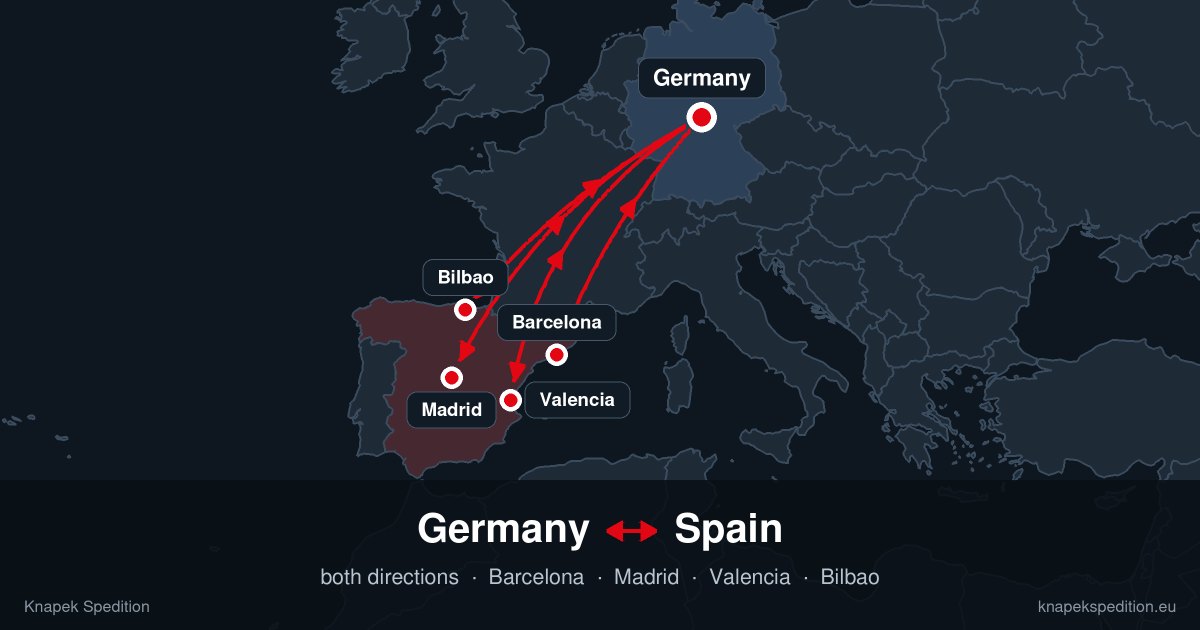
We arrange freight from Spain to Germany as full truckloads, part loads or groupage from a single pallet. From Barcelona to Frankfurt am Main, Munich or Cologne the goods typically arrive in 2–3 days; from Madrid to Berlin, allow 3–4 days. The Czech Republic is not part of this lane: we coordinate the move from Břeclav directly between your Spanish supplier and the German consignee, whether you manufacture, distribute or simply trade the goods.
For general information on collections across Iberia see transport from Spain; deliveries within Germany are covered on transport Germany. This page is only about the Spain → Germany corridor.
How many days does a truck take from Spain to Germany?
| Route | approx. km | Usual transit |
|---|---|---|
| Barcelona → Frankfurt am Main | 1,350 | 2–3 days |
| Barcelona → Munich | 1,400 | 2–3 days |
| Barcelona → Cologne | 1,400 | 2–3 days |
| Barcelona → Berlin | 1,850 | 3–4 days |
| Madrid → Cologne | 1,750 | 3–4 days |
| Madrid → Berlin | 2,350 | 3–4 days |
Catalonia sits right next to the French border, whereas a load from Madrid, Valencia or Andalusia spends its first full day just crossing Spain. The loading day matters too: freight collected on Thursday or Friday often waits out the weekend in France.
La Jonquera or Irún – where does the load leave Spain?
For southern and eastern Germany the truck takes the coastal AP-7 to the La Jonquera / Le Perthus crossing, follows the Rhône valley to Lyon and continues via Mulhouse and Basel onto the A5. Loads from Madrid, Castile or the Basque Country heading for the Rhineland, the Ruhr or Hamburg usually go through Burgos to Irún / Hendaye and on via Bordeaux and Paris. With two pick-ups – say Zaragoza first, then Barcelona – the last collection point decides the crossing.
Collecting in Spain: what to expect region by region
| Loading region | Typical goods for Germany | Loading note |
|---|---|---|
| Barcelona, Martorell, Tarragona | car parts, machine components, packaging | large warehouses load only against a booked slot and order number |
| Zaragoza area | automotive supply parts, goods from logistics parks | on the way from Madrid and Navarre – a natural second pick-up |
| Valencia, Castellón | citrus fruit, ceramic tiles | heavy pallets – we plan by axle weight, not just floor space |
| Almería, Murcia | vegetables and fruit | reefer trailer; the packhouse sets the loading time, confirmed the day before |
| Madrid (Coslada, Getafe) | consumer goods from distribution centres | dock and fixed window – arriving late often means a new date |
| Basque Country, Navarre | metal products, engineering parts | close to Irún, convenient for North Rhine-Westphalia |
Smaller suppliers are more flexible but often have no dock and load from the side with a forklift, so we check in advance whether a side-opening curtainsider is needed.
Delivering in Germany: time slots and driving bans
German distribution centres and wholesalers expect the truck within a pre-booked slot – send us the booking number and we pass it to the driver. Vehicles over 7.5 t may not run on Sundays and public holidays from 0:00 to 22:00, and in July and August a daytime Saturday ban applies on selected motorways. In France heavy trucks stand from Saturday 22:00 to Sunday 22:00 and on the eve of holidays, while Spain publishes its own calendar of restrictions for specific days and roads. Some German holidays apply only in individual federal states, so for drops in Bavaria or the Rhineland we check the regional calendar.
Full truck, part load or groupage?
A curtainsider takes 33 euro pallets on 13.6 loading metres at roughly 24 t. One euro pallet occupies 0.4 ldm, so ten pallets come to about four loading metres – a classic part load. One to five pallets travel as groupage. If you buy from several Spanish suppliers, we collect from each of them and consolidate everything onto one vehicle. An extra drop in the Czech Republic can be added on the way. The same approach applies on freight Spain–Austria and freight Spain–Slovakia; for suppliers in neighbouring countries see France–Germany and Portugal–Germany.
Who books the transport, and which documents travel?
Under EXW or FCA the German buyer books the haulage, so we work for the purchasing side. Under DAP or DDP the Spanish seller arranges it and places the order with us. EU goods move without customs; a CMR consignment note plus delivery note or invoice is enough. Tolls in Spain, France and Germany are included in the price.
What to send us for a quote
- supplier address in Spain and its loading hours,
- order or collection reference,
- delivery address in Germany and any time slot,
- number of pallets or loading metres, weight, stackability,
- temperature requirement or delivery without a dock.
During office hours you receive a price within 30 minutes, and once confirmed we usually arrange the vehicle within 24 hours. We have been forwarding freight since 2011 and work with more than 500 vetted contracted carriers.
Importing from Spain into Germany every week? For fixed loading days in Catalonia or Valencia we can reserve capacity – see regular transport, or simply get in touch.
Related guides: Importing goods from the EU · Refrigerated transport · Preparing pallets