
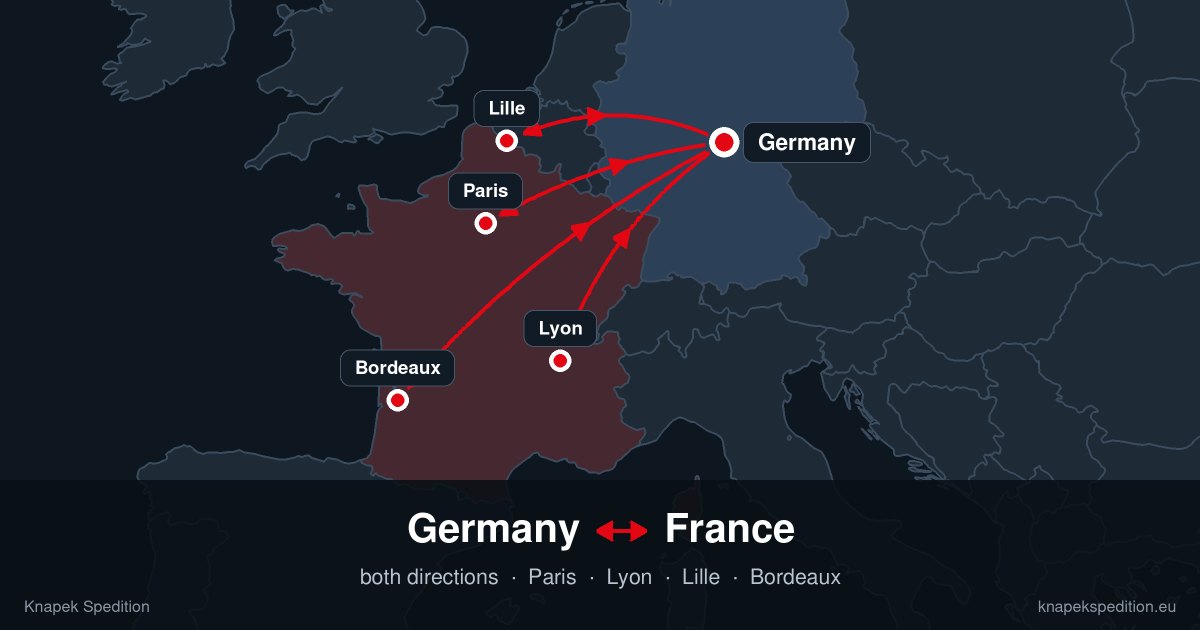
We arrange freight from France to Germany as full truckloads, part loads or groupage from a single pallet, and the goods usually reach the consignee in 1–2 days. Paris to Frankfurt am Main or Lyon to Munich normally means next-day delivery; for Berlin, allow 2–3 days. This lane connects only France and Germany – the Czech Republic is not the destination, although a drop there can be added to the same vehicle.
How fast does a shipment get from France to Germany?
| From – to | approx. km | Usual crossing | Transit |
|---|---|---|---|
| Paris – Cologne | 500 | via Belgium and Aachen | 1–2 days |
| Paris – Frankfurt am Main | 600 | Saarbrücken (Goldene Bremm) | 1–2 days |
| Paris – Munich | 850 | Strasbourg – Kehl | 1–2 days |
| Paris – Berlin | 1,050 | Saarbrücken | 2–3 days |
| Lyon – Frankfurt am Main | 700 | Mulhouse – Neuenburg | 1–2 days |
| Lyon – Munich | 750 | Mulhouse – Neuenburg | 1–2 days |
| Lyon – Berlin | 1,250 | Mulhouse – Neuenburg | 2–3 days |
An early collection in Île-de-France sometimes reaches Frankfurt the same evening, but the usual plan is delivery the next morning at shift start. From Lyon the truck runs via Besançon and Mulhouse, then along the A5 and A8 into Bavaria.
Which crossing from which French region?
- Paris and Champagne – A4 via Reims and Metz; to Hesse and Rhineland-Palatinate through Saarbrücken, to southern Germany on to Strasbourg and over the Europe Bridge to Kehl.
- Alsace and Lorraine – the border is on the doorstep, and goods for Baden-Württemberg or Saarland often arrive the same day.
- Lyon, Grenoble and Franche-Comté – A39 and A36 to Mulhouse, crossing the Rhine between Ottmarsheim and Neuenburg.
- Lille and Hauts-de-France – to the Ruhr and Cologne the shortest way is via Mons, Liège and Aachen; Belgian tolls, like French péage and German Maut, are included in the price.
Collecting in France: rendez-vous bookings, docks and warehouse hours
Large French logistics platforms around Paris, Lyon or Lille load only against a booked appointment (rendez-vous). The driver needs the booking number and order reference, and a late arrival often has to wait for the next free slot. That is why we ask for loading hours and the reference with your enquiry. Smaller producers – wine estates, cheese dairies, engineering workshops – often have no dock and load from the side by forklift, so we book a side-opening trailer.
Wine, cheese, parts and machinery: what needs attention
Champagne from Reims and Épernay and Burgundy wine travel on stretch-wrapped pallets with corner protection; the excise accompanying document is issued by the shipper and we simply carry it with the goods. Cheese from Normandy and the Jura moves in a reefer at the temperature you specify. Car parts from Franche-Comté and Lorraine go to German plants within booked windows, so we plan departure with a buffer. For machines and spare parts from Lyon and Grenoble we need dimensions, weight and fork-lift points.
Weekends on the road: French and German driving bans
In France, trucks over 7.5 t may not run from Saturday 22:00 to Sunday 22:00 or from 22:00 on the eve of a public holiday, and selected summer Saturdays are added. In Germany the ban covers Sundays and holidays from 0:00 to 22:00, plus daytime Saturdays on selected motorways in July and August. A Friday collection is therefore delivered on Saturday if the consignee accepts, otherwise on Monday. Some German holidays apply only in certain federal states, which we factor in for drops in Bavaria or Baden.
One pallet, part load or full trailer?
A full trailer takes 33 euro pallets on 13.6 loading metres at around 24 t; one euro pallet equals 0.4 ldm. Up to about five pallets, groupage is usually the better deal, and larger volumes travel as a part load. If you buy from several French suppliers, we consolidate them onto one vehicle. General collection details are on transport from France, delivery details on transport Germany. We run France–Austria and France–Slovakia the same way; for Iberian suppliers see Spain–Germany and Portugal–Germany.
Who books the transport, and what do we need for a quote?
Under EXW or FCA the German buyer books us; under DAP the French seller does. The goods travel with a CMR note and a delivery note or invoice, with no customs inside the EU. For a quote, send:
- the French supplier's address, loading hours and reference (rendez-vous),
- the delivery address in Germany and any time window,
- pallet count or ldm, weight and stackability,
- any temperature requirement or need for a tail lift.
During office hours you get a price within 30 minutes, and we usually arrange the vehicle within 24 hours of confirmation. We have been forwarding since 2011 with more than 500 vetted contracted carriers.
Shipping from France to Germany every week? For fixed lanes such as Champagne – Hesse or Lyon – Bavaria we agree set loading days – read more about regular transport, or discuss dates with us via contact.
Related guides: Importing goods from the EU · Preparing pallets · Unloading without a dock