
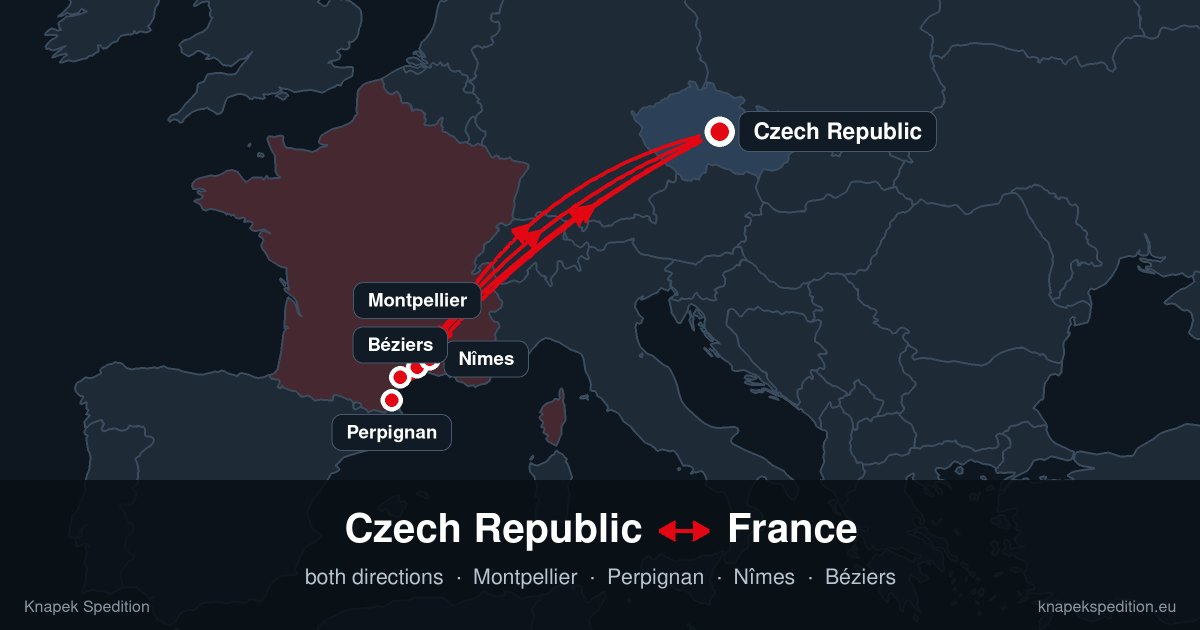
We arrange freight from Montpellier and Perpignan to the Czech Republic, usually in 2–3 days – fresh fruit and vegetables in reefers, Languedoc wine, part loads and groupage from one pallet. Montpellier is about 1,400 km from Prague and roughly 1,600 km from Brno; from Perpignan add around 150 km. We deliver anywhere in the Czech Republic or Slovakia.
How does loading work at Saint-Charles in Perpignan?
On the northern edge of Perpignan, right by the A9, lies Saint-Charles International, one of Europe's largest fruit and vegetable hubs. Produce from Spain and Morocco arrives here, and importers and wholesalers sort, repack and load it onto trucks for France, Germany and further east. A few rules apply to collections there:
- the reefer arrives pre-cooled to the shipper's set temperature, which is logged throughout the journey,
- warehouses load to booked slots, often in the afternoon and evening – we book the vehicle for your exact slot,
- pallets from several importers on the site can share one vehicle if they need the same temperature,
- soft fruit belongs in sturdy crates, not stacked too high, with gaps for cold air and never under heavy pallets,
- imports of vegetables and citrus from Spain and Morocco peak roughly from autumn to spring; in summer apricots and peaches from Roussillon join them.
What else is loaded between Nîmes and Perpignan?
| Area | Typical goods | Vehicle and loading note |
|---|---|---|
| Montpellier | goods from the MIN wholesale market, distribution warehouses, medical supplies, electronics | loading at the time agreed in your enquiry |
| Béziers and the Hérault hinterland | wine in cartons on pallets | closed vehicle; the excise document is issued by the shipper |
| Sète and the Thau lagoon | goods from port warehouses, oysters and mussels from Bouzigues and Mèze | port goods only once released by the importer; shellfish chilled |
| Nîmes and the Gard | Costières de Nîmes wine, mineral water from Vergèze, food, building materials | with water, weight decides, not the pallet count |
| Rivesaltes, Banyuls and the Roussillon plain | sweet wines, fruit | fruit chilled; wine can join a Perpignan pick-up |
Why does a Languedoc load combine so well with goods from Spain?
The A9 is the main artery trucks from Spain use heading north: from the border at Le Perthus via Perpignan, Béziers, Montpellier and Nîmes to Orange, then the A7 to Lyon, on via Besançon and Mulhouse into Germany and past Stuttgart and Nuremberg to the Waidhaus/Rozvadov crossing. A vehicle loading in Catalonia can therefore pick up more pallets in Perpignan or Montpellier with hardly any detour. Goods from Provence can join in the same way – see Marseille. For shipments from inland Occitania, see Toulouse, whose trucks also run up the Rhône valley. French péage, German Maut and the Czech motorway toll are included in the price.
Do weekend driving bans apply to loads from the south?
For vehicles over 7.5 t, France bans driving from Saturday 22:00 to Sunday 22:00 and from 22:00 on the eve of a public holiday; Germany on Sundays and holidays from 0:00 to 22:00. Fresh fruit and vegetables are exempt from the French and German bans, so a reefer from Saint-Charles can keep going over the weekend. Wine, water and other goods are best loaded Monday to Wednesday; a Friday loading usually arrives after the weekend. Wine cooperatives and warehouses in the Hérault load on weekdays, mostly at a dock and at a time agreed in advance.
One pallet, a part load or a full truck?
A full truck takes 33 euro pallets – 13.6 loading metres and around 24 t; one euro pallet takes 0.4 loading metres. A few pallets of wine or mineral water travel as groupage from one pallet; heavy water pallets go on a vehicle with payload to spare. Larger volumes are booked as a part load, paid by the loading metres used. A reefer from Perpignan can drop part of its load in Plzeň and continue to Žilina or Bratislava, for example. Regular importers can use a return load south – glass, packaging, building materials or engineering goods for southern France and Catalonia.
Incoterms, documents and what to send for a quote
If you buy EXW or FCA, you book the transport and we agree the slot with the importer at Saint-Charles or the winery. Under DAP the seller arranges it. EU goods travel without customs on a CMR note with an invoice or delivery note; for wine, excise duty and the accompanying document are handled by consignor and consignee. For a quote we need:
- the pick-up point (Saint-Charles warehouse, winery, port of Sète) and the delivery address,
- pallet count, weight and, for food, the required temperature,
- the slot booking number if the warehouse issues one, and the day the goods are ready.
You get a price within 30 minutes during office hours, and the vehicle is usually arranged within 24 hours of confirmation. Since 2011 we have worked with more than 500 vetted contracted carriers. General information on the whole country is on the transport from France page; more towns in the region are listed below.
Buying vegetables through Perpignan every week? We agree fixed loading days and load the vehicle with Czech goods on its way south – see regular transport, or drop us a line.
Related guides: Refrigerated transport · Food transport · Beverage transport