
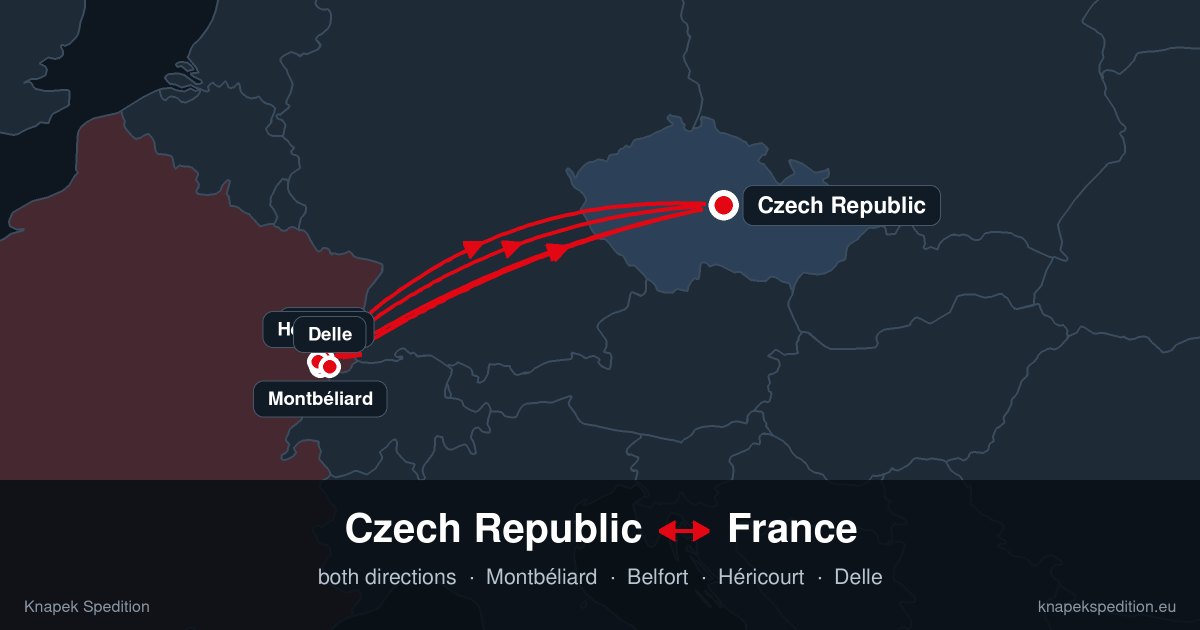
We arrange freight from Montbéliard, Sochaux and Belfort to the Czech Republic with a usual transit of 2–3 days from loading – from a single pallet in groupage, through parts in racks on a mega trailer, to oversized components moving under permit. Prague is about 760 km away and Brno about 970 km, and we deliver to any address in Czechia or Slovakia.
Which route does the truck take, and why not through Switzerland?
Northern Franche-Comté borders Switzerland, yet the vehicle does not cross it: Switzerland is outside the EU, so the goods would need a transit customs document and would stop at two borders. The usual route follows the A36 past Belfort to Mulhouse, crosses the Rhine at Ottmarsheim or Neuenburg onto the German A5, continues to Karlsruhe and then along the A6 via Heilbronn and Nuremberg to the Waidhaus/Rozvadov crossing. The D5 leads on to Prague, the D1 and D2 to Brno and Slovakia.
Pallets from Mulhouse and Colmar can be added on the same axis; if the load is topped up further north in Alsace, the vehicle crosses the Rhine at Strasbourg. In the other direction along the A36 it is a short run to Besançon and to shipments from Dijon and Burgundy. French, German and Czech tolls are included in the price.
What gets loaded in the Pays de Montbéliard and Belfort?
The belt between Sochaux and Belfort is one of the oldest industrial areas in France, shaped by three sectors:
- Automotive – a large car plant in Sochaux and the supplier parks around it, such as Technoland near Étupes; Montbéliard, Audincourt and Héricourt produce pressed and plastic parts, seats, exhaust systems and metal components.
- Energy equipment – turbine and generator parts from Belfort, often heavy and oversized.
- Rail engineering – bogies, wagon bodies and their parts from Belfort works.
- Smaller metalworking – workshops in Delle and nearby on the Swiss border, typically a few pallets.
Which vehicle, and which permit?
Here the size and weight of a single piece decide the vehicle more than the number of pallets:
| Goods | Vehicle | Permit |
|---|---|---|
| car parts in racks and returnable crates | curtain-sider or mega trailer, small volumes by van | not required |
| steel coils | trailer with coil well | not required up to 24 t |
| turbine and generator housings, rotors, stators | low-loader or modular trailer | permits in France, Germany and Czechia, sometimes an escort |
| bogies and wagon bodies | low-loader, often oversized | permit and, depending on size, escort vehicles |
| pallets from smaller workshops | groupage or part load | not required |
How do we ship parts in racks, and what happens to the empties?
Car parts travel in returnable racks and crates that have to go back to the supplier. Our approach:
- We agree a fixed loading window at the supplier park and an unloading window at the Czech or Slovak plant.
- A mega trailer with more internal height takes more racks stacked on top of each other – we work out how many from their dimensions.
- The number and type of load carriers go on the CMR so they can be checked on delivery.
- We collect the empty racks in Czechia and return them to Sochaux or the supplier, ideally together with other freight heading west.
Goods loaded on Friday afternoon usually arrive on Monday or Tuesday, because France bans vehicles over 7.5 t from Saturday 22:00 to Sunday 22:00 and Germany has its Sunday ban. For a plant's Monday shift, load on Thursday.
Oversized loads from Belfort: what should you prepare?
With a machine, a stator or a bogie we start with the route, not the price. Permits are issued country by country and the time they take depends on the dimensions, so ask well in advance. To assess the job we need:
- a drawing or dimensioned sketch with length, width and height,
- the weight and the position of the centre of gravity,
- the loading method – crane, gantry or forklift – and the lashing points,
- whether a crane is available at the delivery site,
- the date the piece is ready for collection.
Who books the transport, and what do we need for a standard shipment?
Under EXW or FCA the buyer arranges the carriage – that is you; under DAP the supplier does. EU goods move duty-free with a CMR and an invoice or delivery note. Groupage starts at one pallet, part loads are priced by loading metres (1 euro pallet = 0.4 ldm), and a full truck takes 33 euro pallets, 13.6 ldm and roughly 24 t. For a quote, tell us the collection and delivery points, type of goods, dimensions, weight, loading hours with a reference and the date you need. You get a price within 30 minutes during office hours, and after confirmation the vehicle is usually arranged within 24 hours. Since 2011 we have worked with more than 500 vetted contracted carriers. Other regions are covered on our page on transport from France.
Feeding your line with parts from Sochaux several times a week? We agree fixed unloading slots and regular return of empty racks – regular transport, or get in touch.
Related guides: Automotive freight · Machinery transport · Steel transport