
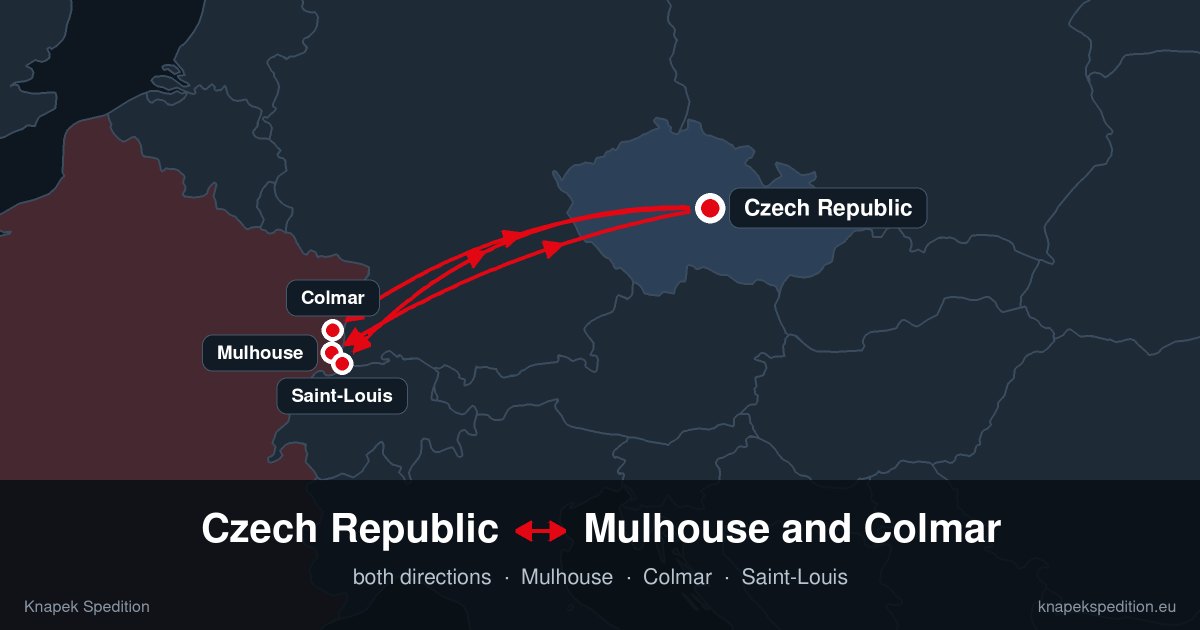
We arrange freight from Mulhouse and Colmar to the Czech Republic in 1–2 days as a rule – goods loaded in Upper Alsace in the morning usually reach the consignee the next day. Typical loads are wine and crémant from the villages, parts from the automotive plants around Mulhouse and palletised stock from the warehouses near Saint-Louis, anything from one pallet to a full truck. Prague is about 700 km away, Brno about 900 km, and we deliver to any address in the Czech Republic or Slovakia.
Where in Upper Alsace do we collect, and what?
Upper Alsace is compact but its freight is varied: wine dominates south of Colmar, industry surrounds Mulhouse and transhipment warehouses sit along the Swiss border. The vehicle and the way the loading works depend on the place:
| Collection point | Typical goods | What to prepare |
|---|---|---|
| Mulhouse, Sausheim | automotive parts and components | dock loading in an allocated slot; agree returnable packaging and pallet exchange in advance |
| Colmar and the Wine Route (Eguisheim, Turckheim, Obermorschwihr, Riquewihr) | wine and crémant in cartons | narrow lanes and small yards – often side loading or a smaller vehicle |
| Guebwiller | grand cru wines | usually just a few pallets, a natural fit for groupage |
| Munster valley | cheese | refrigerated vehicle; goods must already be chilled at loading |
| Saint-Louis, Mulhouse-Rhin port at Ottmarsheim | warehouse stock, transhipped goods | loading by appointment only; the driver quotes the order number |
Distances between these places are short, so one vehicle routinely covers two or three pickups in a single day.
Which way does the truck go – and why not through Basel?
Basel looks like the obvious shortcut, but Switzerland is outside the EU: the load would need a transit document and could queue at two borders. From Mulhouse we therefore take the A36 over the Rhine at Ottmarsheim to Neuenburg; from Colmar the usual crossing is Neuf-Brisach to Breisach. In Germany the A5 runs past Freiburg to Karlsruhe, then via Heilbronn to Nuremberg and the Waidhaus/Rozvadov crossing. The D5 leads on to Plzeň and Prague, the D1 to Moravia and Slovakia. French and German tolls and the Czech electronic toll are included in the price.
If you also buy in northern Alsace, the same truck can top up on the way – see freight from Strasbourg. Beyond the Belfort Gap, less than an hour to the south-west, lies the industrial area covered on our Montbéliard and Belfort page. Loads from the Rhône valley also pass Mulhouse on the A36, so they can be combined with a shipment from Lyon. Nancy and Metz use a separate route through the Saarland, described under freight from Lorraine.
How do Friday loadings and the local holidays work?
France bans vehicles over 7.5 t from Saturday 22:00 to Sunday 22:00 and from the evening before a public holiday; Germany bans them on Sundays and holidays from 00:00 to 22:00. Because the distance is short, a Friday-morning collection can often clear Germany on Saturday, so your goods do not sit in a lay-by over the weekend. In summer some German motorways add Saturday restrictions, which we build into the schedule.
Alsace and Moselle keep two public holidays the rest of France does not: Good Friday and St Stephen's Day after Christmas. Many companies and wine estates do not load on those days, so it pays to check with the supplier.
Alsace wine: checklist before the truck arrives
- The sender issues the excise document – an e-AD for wine under duty suspension, an e-SAD for duty-paid wine.
- The consignee in the Czech Republic or Slovakia is registered with the customs or tax authority to receive wine.
- Cartons do not overhang the pallet, corners are protected and the whole pallet is stretch-wrapped; we advise against tall stacking.
- In summer we load in the morning and avoid weekend stops; a temperature-controlled trailer is available on request.
- During the harvest (roughly September to October) and before Christmas, book about a week ahead.
A few pallets, a part load or a full truck?
Wine growers often ship only a handful of pallets. Groupage from 1 pallet is the economical choice; a van for about 5 pallets or a larger vehicle for about 10 is faster. One euro pallet takes 0.4 loading metres, so ten pallets need about 4 ldm – already a part load with its own space on the trailer. Automotive parts, by contrast, often move as a full truck: 33 euro pallets, 13.6 ldm, around 24 t.
Buying from several suppliers? Along the A35 we link Guebwiller, Colmar and Mulhouse into one run, so you pay for one transport instead of three. Under EXW or FCA the buyer books the carriage – you contact us and we agree the slot with the supplier directly. Under DAP the seller arranges it. EU goods travel without customs; a CMR note plus invoice or delivery note is all you need. For the country overview see transport from France.
What to send for a Mulhouse or Colmar quote
- the supplier's address (every one if there are several pickups) and the delivery point in the Czech Republic or Slovakia,
- loading hours of the warehouse or estate and the loading reference,
- number of pallets or loading metres, pallet height and total weight,
- for wine the type of excise document, for cheese the required temperature,
- the ready date and the latest delivery date.
In office hours you receive a price within 30 minutes, and once you confirm, the vehicle is usually arranged within 24 hours. Since 2011 we have worked with more than 500 vetted contracted carriers.
Buying Alsace wine every season? For regular collections in Colmar, Mulhouse and the wine villages we agree fixed dates and combine several stops into one run – read more about regular transport or write to us via contact.
Related guides: Beverage transport · Automotive freight · Preparing pallets