
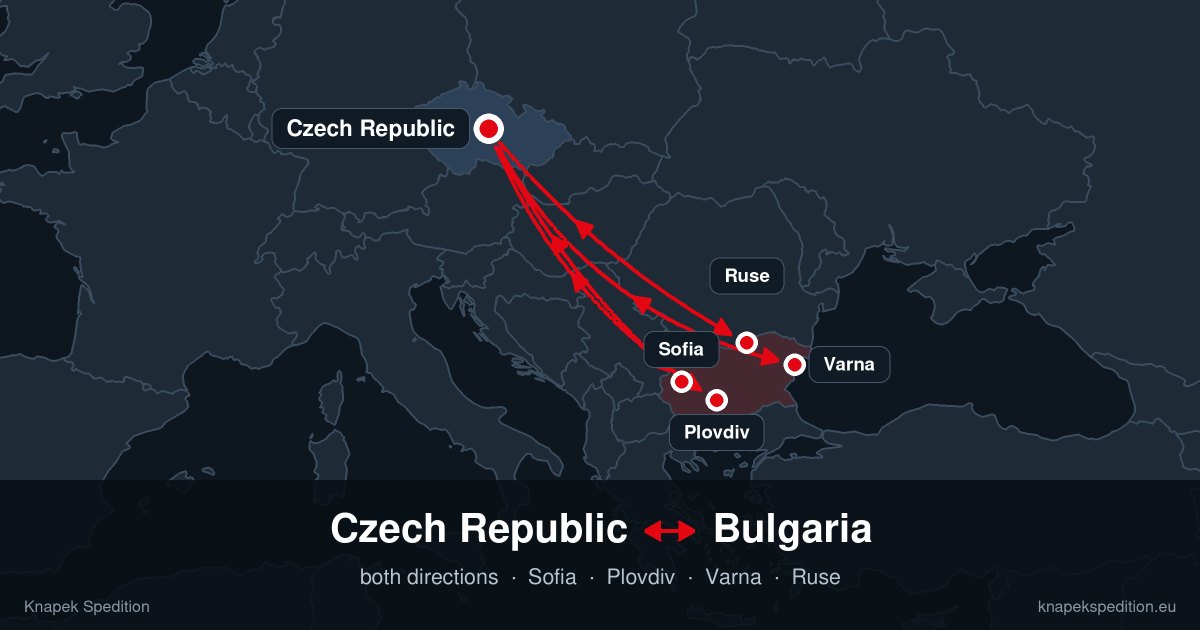
We arrange freight from Bulgaria to the Czech Republic and Slovakia from Sofia, Plovdiv, Varna and smaller towns across the north and south of the country. A truck from Bulgaria normally reaches you within 3 days of loading. We move single pallets as groupage, part loads and full trucks, routing via Romania or via Serbia depending on the pickup point and the paperwork.
Whether it is goods for trade or material for manufacturing – food and clothing – we collect it directly from your supplier in Bulgaria. For the other direction see freight to Bulgaria.
How long does freight from Bulgaria to the Czech Republic take?
Allow up to 3 days from loading to delivery. Sofia is about 1,100 km from Brno and 1,300 km from Prague, Plovdiv just under 150 km further, and Varna on the Black Sea around 1,400 km from Brno. The loading day matters most: a Friday collection can run into weekend restrictions. In the Czech Republic vehicles over 7.5 t may not drive on Sundays and public holidays between 13:00 and 22:00, in July and August there are extra limits on Friday afternoon and Saturday morning, and transit countries have rules of their own. For Friday loadings we therefore plan a spare day.
Via Romania or via Serbia?
Bulgaria has no border with Hungary, so the truck has to cross one of two countries on its way north.
| Route | Crossings and documents | Best for |
|---|---|---|
| Via Romania | Danube bridge Vidin–Calafat or Ruse–Giurgiu, then Nădlac; entirely within the EU and Schengen, no customs papers | Varna, Ruse, Burgas and the north; shipments where nobody wants transit formalities |
| Via Serbia | Kalotina, Belgrade, Horgoš–Röszke; T1 transit document from the shipper's customs agent | Sofia and the south-west, once the document is ready |
Both routes meet in Hungary and run via Bratislava to Brno and Prague, so drops in Žilina, Nitra or Košice are on the way. Bulgarian distance-based tolls, Danube bridge fees, the Romanian rovinieta and tolls in every other country are included in the price we quote.
Where in Bulgaria companies import from
| Area | Typical goods | Usual route north |
|---|---|---|
| Sofia and surroundings | electrical goods, beverages, distribution-centre stock | Serbia, or the bridge at Vidin |
| Plovdiv and Upper Thrace | preserved vegetables, wine, parts from industrial zones | via Sofia and Serbia, or via Ruse |
| Stara Zagora and Kazanlak | engineering products, farm produce | via Ruse and Romania |
| Ruse and the Danube north | components, metal parts | Ruse–Giurgiu bridge |
| Varna and Burgas | port cargo, glass and packaging, food | via Ruse and Romania |
| Blagoevgrad and the south-west | garments and textiles from sewing workshops | via Sofia, then Serbia or Vidin |
What collection in Bulgaria looks like
Large warehouses around Sofia and in the industrial zones near Plovdiv load at docks within their own time slots, some only in the morning. Sewing workshops and smaller producers often have no dock – a curtain-sider loaded from the side or a van with a tail lift solves that. In summer the roads to the coast get busy, so we confirm Varna and Burgas loadings early. Around Orthodox Easter and the national holidays in spring and September many warehouses close; check the date with your supplier.
- town or four-digit Bulgarian postcode and the exact address,
- warehouse opening hours and a contact person,
- the order number the goods will be released under,
- dock, side or ground-level loading,
- set temperature for chilled goods.
One pallet, a part load or a full truck?
Groupage starts at 1 pallet and works well up to about six pallets, sharing the vehicle with other customers. For larger volumes, roughly 7 to 20 euro pallets, a direct part load without transhipment is the better choice. A full trailer gives 13.6 loading metres, 33 euro pallets and about 24 t; one euro pallet takes 0.4 loading metres. Urgent samples or spare parts go by van.
Several Bulgarian suppliers on one vehicle
Sofia and Plovdiv lie on the same motorway, Varna and Ruse are close together in the north-east, and the sewing workshops around Blagoevgrad sit on the road to Sofia. That means purchases from two or three companies can travel in a single run instead of paying for separate vehicles. We suggest the loading order in the quote. For regular imports we set fixed loading days and stable terms, and we deliver anywhere in the Czech Republic and Slovakia, including warehouses with booked time slots.
Chilled food and wine from Bulgaria
White cheese, yoghurt and fresh vegetables travel in a reefer that holds the set temperature all the way – in summer, sensitive confectionery too. Wine, sunflower oil, honey and tinned goods are fine on pallets in a covered curtain-sider. For wine, the winery issues the excise accompanying document that travels with the load.
Who books the transport and what paperwork is needed?
If you buy EXW or FCA, transport is yours to arrange – you book it with us and we collect. Under DAP the Bulgarian supplier handles it. EU goods need only a CMR plus an invoice or delivery note, with no duty to pay. We do not carry out customs clearance ourselves: for the Serbian route the shipper's agent issues the transit document, and overseas containers in Varna or Burgas must be released before loading.
What to include in your enquiry
- supplier address and delivery point in the Czech Republic or Slovakia,
- loading hours and reference,
- pallets or loading metres and weight,
- type of goods, temperature if relevant, and ready date.
A quote reaches you within 30 minutes during office hours, and we usually arrange the vehicle within 24 hours of confirmation. We have been in business since 2011 and work with more than 500 vetted contracted carriers. More on individual cities: Sofia, Plovdiv and Varna; further places and a map are below. For shipments the other way, see transport to Bulgaria.
Importing from Bulgaria on a regular basis? We set fixed loading days, a fixed Danube route and a long-term rate – see regular transport, or contact us directly.
Related guides: Food transport · Textile transport · Preparing pallets