
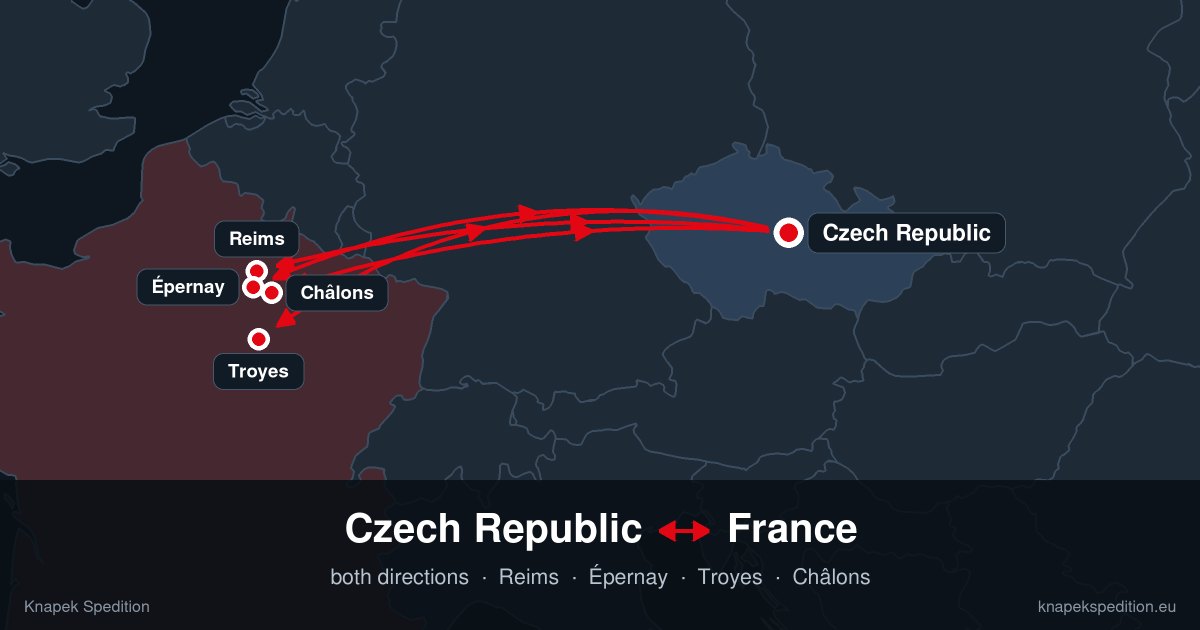
We arrange freight from Reims and Champagne to the Czech Republic, usually in 2–3 days from loading – sparkling wine, biscuits, knitwear from Troyes and castings from the Ardennes. Reims is one of the closest French regions: Prague is about 890 km away and Brno about 1,100 km. We handle full trucks, part loads and groupage from one pallet, delivering anywhere in the Czech Republic or Slovakia.
Where in Champagne do we load, and with what vehicle?
| Area | Typical load | Vehicle and loading |
|---|---|---|
| Reims | sparkling wine from the cellars, biscuits and confectionery, packaging | box or curtainsider; in winter temperature-controlled above zero |
| Épernay, Montagne de Reims, Côte des Blancs | wine from large houses and small growers | often several pick-ups in the villages; a smaller vehicle where an artic cannot turn |
| Châlons-en-Champagne | grain, sugar beet, dried alfalfa, seed | sacks and big bags on pallets; loose bulk only if agreed beforehand |
| Troyes | knitwear, hosiery, clothing in cartons | box body to keep out damp; cartons also as groupage |
| Charleville-Mézières and the Meuse valley | castings, forgings, metal parts for vehicles and machinery | pallets and crates; piece weights and sizes for load distribution |
How do we get wine in glass there in one piece?
Bottles of sparkling wine cope well with a long journey if they are loaded properly. What counts is how the pallet is packed, how it is stowed in the vehicle and, in winter, the temperature. Before collection, check with your supplier that:
- cartons do not overhang the pallet edge, corners carry edge protectors and the stretch film is tight,
- gaps between cartons are filled so nothing shifts under braking,
- pallets are stacked only if the packaging expressly allows it – otherwise we plan a single layer,
- in November and December wine can freeze in the bottle in hard frost and the glass can crack, so we book a vehicle held above zero,
- biscuits from Reims tolerate the same conditions as wine, so they can share the vehicle.
Excise duty and the accompanying document are handled by consignor and consignee: goods under duty suspension travel with an e-AD in EMCS, duty-paid goods with the simplified accompanying document. We carry the load with those papers and the CMR note, and we can unload at a tax warehouse in the Czech Republic or Slovakia.
When should you book for the Christmas season?
Most loads leave Champagne between October and December. Autumn capacity goes quickly, so it pays to send an estimate of pallets and dates in early October, early November at the latest. In December, public holidays and weekend driving bans shorten the calendar: in France vehicles over 7.5 t may not run from Saturday 22:00 to Sunday 22:00 and from 22:00 on the eve of a holiday, in Germany on Sundays and holidays from 0:00 to 22:00, and in the Czech Republic on Sundays and holidays from 13:00 to 22:00. We therefore schedule the last loadings for pre-holiday delivery around mid-December, with a margin. Cellars and warehouses in Reims and Épernay usually load on weekday mornings and afternoons, often only at an agreed time.
Which way does the truck run, and what can join the load?
From Reims the truck takes the A4 past Verdun and Metz to the German border at Saarbrücken, then the A6 via Mannheim and Nuremberg to the Waidhaus/Rozvadov crossing and the D5 via Plzeň to Prague. Loads from Troyes join via the A26, from Charleville-Mézières via the A34. French, German and Czech tolls are included in the price. Metz sits right on the A4 and Nancy a short way south, so a second stop in Lorraine fits the run well. Trucks from the Atlantic coast and from Paris use the same motorway, and goods from Lille can join from the north via Saint-Quentin.
Groupage, part load or full truck?
A full truck takes 33 euro pallets, i.e. 13.6 loading metres and about 24 t; one euro pallet occupies 0.4 loading metres. A few cartons of wine or knitwear from one grower or maker travel as groupage from one pallet. For larger volumes you book a part load and pay for the loading metres used. If you buy from several small growers on the Côte des Blancs or the Montagne de Reims, we build one vehicle with consecutive pick-ups – we only need the addresses and carton count per grower. Regular importers can also use a return load into the region, such as packaging, glass or machine parts.
Who pays for the transport, and what should you send us?
Under EXW or FCA the Czech or Slovak buyer books the transport, and we agree the date with the grower or warehouse. Under DAP the seller arranges it. EU goods travel without customs – besides the CMR an invoice or delivery note is enough, plus the excise document for wine. For a quote we need the cellar or warehouse address, loading hours and reference, pallet count and weight, stackability, the delivery point and, for wine, the excise status. You get the price within 30 minutes in office hours, and the vehicle is usually arranged within 24 hours of confirmation. Since 2011 we have worked with a network of over 500 vetted contracted carriers. For a country-wide overview, see transport from France; more towns in the region are listed below.
Importing from Champagne every season? We reserve autumn capacity and fixed loading days for you – regular transport, or send us a message.
Related guides: Beverage transport · Food transport · Preparing pallets