
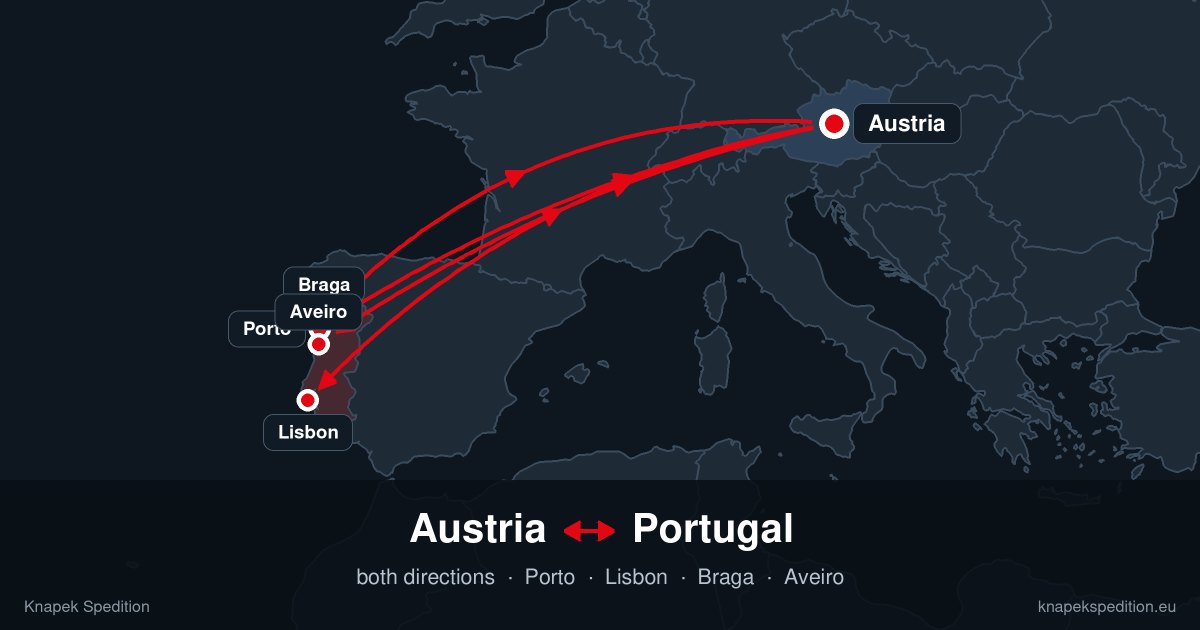
We arrange freight from Portugal to Austria as full truckloads, part loads and groupage from one pallet. From Porto to Linz, Graz or Vienna a truck usually takes 3–4 days; from Lisbon to Vienna and Graz allow 4–5 days. The Austrian consignee buys in Portugal, and we, a forwarder based in Břeclav, organise the leg between the two countries – the Czech Republic is at most an extra stop along the way.
General notes on collections in Portugal are on transport from Portugal, and deliveries and Austrian rules on transport Austria. This page covers only the Portugal → Austria lane, one of the longest we plan in western Europe.
How far is it from Portugal to Austria, and how many days does that mean?
| From – to | approx. km | Indicative transit |
|---|---|---|
| Porto – Linz | 2,600 | 3–4 days |
| Porto – Graz | 2,700 | 3–4 days |
| Porto – Vienna | 2,750 | 3–4 days |
| Lisbon – Linz | 2,750 | 3–4 days |
| Lisbon – Graz | 2,850 | 4–5 days |
| Lisbon – Vienna | 2,900 | 4–5 days |
Why not faster? Under EU rules a driver may drive at most 9 hours a day and must take breaks, so a single-driver truck covers roughly 650–750 km per day. Over almost three thousand kilometres that means arrival on day four, sometimes day five. Only an express vehicle with two drivers shortens this – ask for it separately.
The Austrian weekend starts at 15:00 on Saturday – so when should you load?
Trucks over 7.5 t may not run in Austria from Saturday 15:00 to Sunday 22:00, nor on public holidays from 0:00 to 22:00. On the way there is also the French ban from Saturday 22:00 to Sunday 22:00 and the German Sunday ban. A truck that does not reach the Austrian consignee by Saturday afternoon unloads on Monday. In practice: load in Portugal on Monday or Tuesday if the goods must arrive within the same week. Many Austrian roads also have night restrictions for noisy vehicles, so we plan deliveries in daytime hours and give the consignee an estimated arrival time.
Walserberg or Suben: where does the truck enter Austria?
From Portugal the route runs through Spain and France into Germany. If the truck crosses southern Germany via Munich, it enters Austria at Walserberg near Salzburg – the usual choice for Salzburg, Styria and Carinthia. Via Passau and the Suben crossing it heads for Linz and Upper Austria, and on to Vienna if needed. We avoid the route through Switzerland: it is outside the EU, so the goods would need transit customs documents, and driving restrictions there are stricter. Portuguese and Spanish tolls, French péage, German Maut and the Austrian GO-Maut are included in the price.
Furniture, ceramics, cork, wine: getting the load ready for the road
| Goods | How to secure | Charged by |
|---|---|---|
| furniture | blankets, straps, load bars, often side loading | loading metres |
| ceramics and porcelain | pallet wrapped in film and strapped, do not stack | loading metres and pallet count |
| cork | light bales, protect from moisture | almost always volume |
| wine | cartons on pallets, watch temperature in summer | weight |
| tinned fish | heavy pallets, spread evenly | weight |
| textiles | cartons on pallets | volume |
Over nearly three thousand kilometres the load is braked and accelerated many times – a well-secured pallet costs less than a claim for broken ceramics.
How many pallets, which vehicle?
A standard curtainsider takes 33 euro pallets – 13.6 loading metres – and around 24 t. One euro pallet occupies 0.4 ldm. From one pallet the goods travel as groupage; for a few pallets up to half a trailer a part load fits, above that usually a full vehicle. If you buy from several Portuguese manufacturers – furniture and ceramics, for example – we combine the collections in one truck so the long distance is shared.
Vienna first, then Brno or Bratislava – one trip, several drops
After unloading in Vienna, continuing to Brno or Bratislava adds little distance, so combined deliveries pay off on this lane. Slovakia also has its own lane, freight Portugal–Slovakia, and Germany freight Portugal–Germany. If your company also buys in Spain or France, we plan Spain–Austria and France–Austria the same way.
Who books, which documents, and what goes into the enquiry?
Under EXW or FCA the Austrian buyer books the transport; under DAP the Portuguese supplier does. No customs clearance is needed within the EU – an invoice or delivery note and a CMR are enough.
- collection address in Portugal and loading hours,
- reference or order number for the pick-up,
- delivery address in Austria and any further stop,
- pallets or loading metres, weight, stackability,
- date the goods are ready.
You receive the quote within 30 minutes during office hours, and after confirmation the vehicle is usually arranged within 24 hours. We have been forwarding since 2011 with more than 500 vetted contracted carriers.
Supplying an Austrian warehouse from Portugal on a regular basis? We agree a fixed weekly loading rhythm and a stable rate – see regular transport, or send questions via contact.
Related guides: Importing goods from the EU · Furniture transport · Preparing pallets